The what, where and the how of it all!!!!!!!!!!

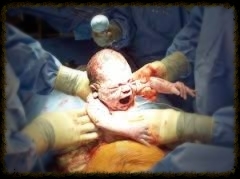
Caesarean Sections Happen!!!!!!!!

  • Caesarean section is a common operative procedure, with the proportion of women giving birth by caesarean section increasing over time in all developed countries over the past several decades (Grivell & Dodd, 2011).
  • The most current NZ statistics show that 1:4 women deliver by caesarean section (up 21.3% since 2001).


Normal

Emergency

Elective

Total

ADHB

4111

1197

1275

2472

CMDHD

5723

926

536

1464

Waitemata

4215

1009

741

1750

(Ministry of Health, 2010)

Contributing factors for SSIs following caesarean birth:

Pre – existing maternal conditions

Events during labour or birth

Procedure/provider related conditions and events

Extremes of maternal age

Preterm labour and birth

Pre-operative shaving

Elevated body mass index

Prolonged rupture of membranes

Pre-operative skin preparation techniques

Smoking

Prolonged labour

General anaesthesia

Primiparity

Intrapartum fever/pyrexia

Hypothermia

Low socio-economic status

Multiple vaginal examinations

Poor aseptic technique

Poor maternal hygiene

Post-term pregnancy

Inadequate sterilisation of instruments

Poor nutrition

Thick meconium staining

Delayed or omitted prophylactic antibiotics

Poor oxygenation

Internal fetal scalp electrode

Suboptimal haemostasis

Poor tissue perfusion

Uterine monitoring with an interuterine pressure catheter

Practitioner skill

Multiple comorbidities

Operative vaginal birth

Practitioner experience

Diabetes

Foley catheter

Length of procedure

Hypertension

Caesarean birth

Operative trauma

Immune compromise

Manual removal of placenta

Contamination of wound or surgical site

Splenectomy

Retained products of conception

Residual dead space following wound closure

Severe anaemia

Uterine perforation


Infection: bacterial vaginosis, chlamydia, gonorrhoea, trichomonis


(Maharaj, 2007; Schneid-Kofman, Sheiner, Levy, & Holcberg, 2005; Ward, Charlett, Fagan, & Crawshaw, 2008)
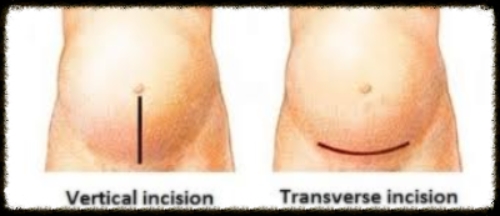
Indications for caesarean section:

  • Prior caesarean section
  • Dystocia or cephalo pelvic disproportion
  • Breech presentation
  • ‘Non reassuring’ fetal heart rate tracing   (Tracy, 2008)

Main Causative Organisms:

  • Staphylococcus aureus (30%)
  • Coagulase – negative staphylococci (13.7%)
  • Enterococcus spp (11.2%) (Hidron et al., 2008)

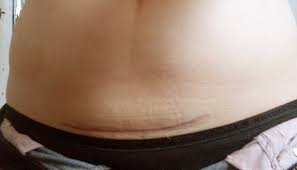
Recommended Principles for Post-Operative LSCS Wound Care:

  • The theatre dressing can be removed after 24hours – aids healing and reduces chance of infection (Review current hospital guidelines as may differ due to current research or use of dressings
  • The woman should shower daily, the wound being carefully dried gently and loose cotton clothing being worn
  • The wound should be assessed then, and on every postoperative day after that whilst in hospital and every postnatal visit until care is discharged/transferred
  • Suture/clip/staple removal is planned – (see below)
  • If the wound is exuding excess fluid or can catch on clothing, a dressing should be re applied, otherwise may be left uncovered
  •   If a wound requires redressing it should be with a suitable non-adherent dressing that retains moisture
  •   If a wound requires cleansing and re dressing it should be with a clean (aseptic) technique, using body temperature (warmed slightly) normal saline or tap water, using either sterile gauze or foam swabs, and a suitable dressing (see hospital guidelines).
  •  If a wound appears infected a wound swab may be taken and a referral made. Assessment may be made in conjunction with obstetrician.
  •  A wound that is hot, tender and inflamed and is accompanied by pyrexia is highly suggestive of an infection (Consultation/Transfer).
  •   Women should be advised to monitor temperature/ be aware.
  •  Haematoma and abscesses can also form underneath the wound, and women may identify increased pain around the wound where these are present (Consultation/Transfer)
  • Healthcare professionals caring for women who have had a CS should be aware that heavy and/or irregular vaginal bleeding should consider that this is more likely to be due to endometritis than retained products of conception.                                                                                         (Fraser & Cooper, 2008;Johnson & Taylor, 2006; NICE, 2008)

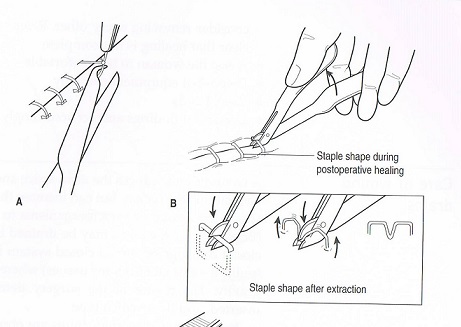
Staples –
(Figure B)
  • Hold the staple remover as if a pair of scissors
  • Insert lower blade directly under staple
  • Squeeze the handles together; the staple will be lifted from the skin as it concertinas.
  • Lift clear                                       (Johnson & Taylor, 2006)

Removal of Sutures or Staples

  • The decision to remove sutures is taken according to the assessment of healing of the wound. Sutures are removed when the wound has healed, i.e skin edges in close apposition without signs of infection; this is often 5-10 days after surgery. Sutures that are retained too long can delay wound healing
  • Use aseptic technique!!!!!               Sutures – (Figure A)
  • Lift and hold the external part of the suture with forceps using non-dominant hand.
  • Cut beneath the knot as near to the skin as possible using scissors or stitch cutter in the dominant hand.
  • Remove the suture by pulling it gently through the skin.          
  •  This principle applies whether the sutures are interrupted, continuous or subcuticular.
  • A continuous suture requires the midwife to lift, cut and pull through repeatedly, until the end of the suture is removed.
  • Subcuticular suturing that is held in place with a bead should have the bead removed at the distal end of the wound so that on removal the suture is pulled from the end nearest the midwife
  • The removal should be smooth; the woman may experience the pulling sensation rather than discomfort.